Section 5 Guided Reading and Review Russia Reform and Reaction
Stalin's Five Year Plan
Leon Trotsky, Gregory Zinoviev, Lev Kamenev and other left-fly members of the Politburo had ever been in favour of the rapid industrialisation of the Soviet Union. Stalin disagreed with this view. He accused them of going against the ideas of Lenin who had alleged that it was vitally important to "preserve the alliance between the workers and the peasants." When left-wing members of the Politburo advocated the building of a hydro-electric ability station on the River Druiper, Stalin accused them of existence 'super industrialisers' and said that information technology was equivalent to suggesting that a peasant buys a "gramophone instead of a cow." (1)
When Stalin accepted the need for collectivisation he also had to change his mind near industrialisation. His advisers told him that with the modernisation of farming the Soviet Marriage would crave 250,000 tractors. In 1927 they had simply 7,000. As well as tractors, there was also a need to develop the oil fields to provide the necessary petrol to drive the machines. Power stations as well had to exist built to supply the farms with electricity.
Nonetheless, Stalin suddenly changed policy and made it clear he would use his control over the country to modernize the economy. The first Five Year Plan that was introduced in 1928, concentrated on the evolution of fe and steel, auto-tools, electric ability and transport. Stalin set the workers loftier targets. He demanded a 111% increment in coal production, 200% increase in iron production and 335% increase in electric power. He justified these demands by claiming that if rapid industrialization did not take place, the Soviet Union would not be able to defend itself confronting an invasion from capitalist countries in the westward. (two)
James William Crowl has argued in that location were political reasons for the introduction of the Five Year Program: "Stalin With the defeat of Trotsky and the Left Wing in 1927, Stalin apparently began to look for a way to outmaneuver the final ability bloc in the Party: the Correct Wing led by Bukharin, Rykov and Tomsky. Information technology was not past accident that the economy provided him with the issues he needed to destroy his onetime allies. Midway through 1927 the Politburo had initiated an ambitious economic program that included a number of expansive construction projects such equally the Turkish-Siberia railroad and the Dnieper dam. Such an undertaking involved a risk since it was to exist underwritten largely by the sale of grain, and the grain drove program had become increasingly unreliable during the mid-1920'due south." (3)
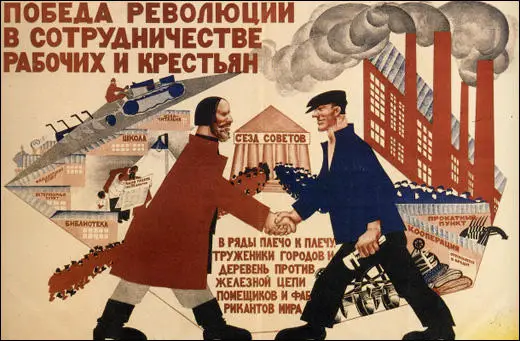
The get-go Five-Twelvemonth Plan did not become off to a successful starting time in all sectors. For case, the production of grunter iron and steel increased by only 600,000 to 800,000 tons in 1929, barely surpassing the 1913-fourteen level. Merely three,300 tractors were produced in 1929. The output of food processing and light industry rose slowly, only in the crucial expanse of transportation, the railways worked specially poorly. "In June, 1930, Stalin announced sharp increases in the goals - for pig iron, from 10 million to 17 million tons by the last year of the program; for tractors, from 55,000 to 170,000; for other agricultural machinery and trucks, an increase of more than 100 per cent." (4)
Every manufacturing plant had large display boards erected that showed the output of workers. Those that failed to accomplish the required targets were publicity criticized and humiliated. Some workers could not cope with this pressure level and absence increased. This led to even more repressive measures being introduced. Records were kept of workers' lateness, absenteeism and bad workmanship. If the worker's record was poor, he was defendant of trying to sabotage the Five Year Plan and if establish guilty could be shot or sent to piece of work as forced labour on the Baltic Bounding main Canal or the Siberian Railway. (5)
I of the most controversial aspects of the Five Yr Plan was Stalin's decision to move abroad from the principle of equal pay. Under the rule of Lenin, for example, the leaders of the Bolshevik Party could not receive more than the wages of a skilled labourer. With the modernization of industry, Stalin argued that it was necessary to pay higher wages to certain workers in order to encourage increased output. His left-wing opponents claimed that this inequality was a betrayal of socialism and would create a new grade organisation in the Soviet Wedlock. Stalin had his manner and during the 1930s, the gap between the wages of the labourers and the skilled workers increased. (6)
Co-ordinate to Bertram D. Wolfe, during this menses Russia had the about highly concentrated industrial working class in Europe. "In Germany at the turn of the century, only fourteen per cent of the factories had a force of more five hundred men; in Russia the corresponding figure was thirty-four per cent. Only eight per cent of all German workers worked in factories employing over a thousand working men each. Twenty-four per cent, about a quarter, of all Russian industrial workers worked in factories of that size. These giant enterprises forced the new working grade into close clan. There arose an insatiable hunger for organization, which the huge state machine sought in vain to direct or concur in cheque." (7)
Joseph Stalin now had a trouble of workers wanting to increase their wages. He had a particular problem with unskilled workers who felt they were not beingness adequately rewarded. Stalin insisted on the need for a highly differentiated scale of textile rewards for labour, designed to encourage skill and efficiency and "throughout the thirties, the differentiation of wages and salaries was pushed to extremes, incompatible with the spirit, if not the alphabetic character, of Marxism." (8)
Stalin gave instructions that concentration camps should non just be for social rehabilitation of prisoners merely also for what they could contribute to the gross domestic product. This included using forced labour for the mining of gold and timber hewing. Stalin ordered Vladimir Menzhinski, the master of the OGPU, to create a permanent organisational framework that would allow for prisoners to contribute to the success of the 5 Year Programme. People sent to these camps included members of outlawed political parties, nationalists and priests. (nine)
Robert Service, the author of Stalin: A Biography (2004), has pointed out: "During the Beginning Five Year Plan the USSR underwent drastic change. Ahead lay campaigns to spread commonage farms and eliminate kulaks, clerics and private traders. The political system would become harsher. Violence would be pervasive. The Russian Communist Political party, OGPU and People'due south Commissariat would consolidate their power. Remnants of former parties would be eradicated… The Gulag, which was the network of labour camps subject to the People's Commissariat of Internal Affairs (NKVD), would be expanded and would go an indispensable sector of the Soviet economic system… A peachy influx of people from the villages would have place every bit factories and mines sought to fill their labour forces. Literacy schemes would be given huge state funding… Enthusiasm for the demise of political, social and cultural compromise would exist cultivated. Marxism-Leninism would be intensively propagated. The modify would be the work of Stalin and his associates in the Kremlin. Theirs would be the credit and theirs the blame." (10)
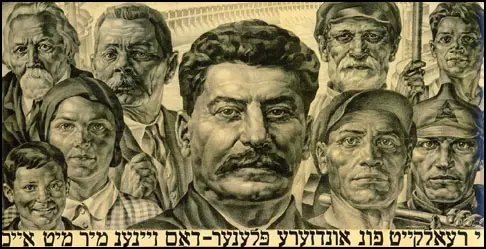
Eugene Lyons was an American announcer who was fairly sympathetic to the Soviet government. On 22nd November, 1930, Stalin selected him to be the first western journalist to exist granted an interview. Lyons claimed that: "One cannot alive in the shadow of Stalin'south fable without coming under its spell. My pulse, I am sure, was high. No sooner, however, had I stepped across the threshold than diffidence and nervousness barbarous abroad. Stalin met me at the door and shook hands, smiling. There was a certain shyness in his smile and the handshake was not perfunctory. He was remarkably unlike the scowling, self-important dictator of pop imagination. His every gesture was a rebuke to the thou little bureaucrats who had inflicted their puny greatness upon me in these Russian years.... At such close range, there was not a trace of the Napoleonic quality i sees in his self-conscious camera or oil portraits. The shaggy mustache, framing a sensual mouth and a smile most every bit full of teeth equally Teddy Roosevelt's, gave his swarthy face a friendly, most benignant wait." (xi)
Walter Duranty was furious when he heard that Stalin had granted Lyons this interview. He protested to the Soviet Press office that as the longest-serving Western correspondent in the country it was unfair not to give him an interview as well. A week afterwards the interview Duranty was too granted an interview. Stalin told him that after the Russian Revolution the capitalist countries could take crushed the Bolsheviks: "But they waited too long. It is now too late." Stalin commented that the U.s.a. had no selection but to sentinel "socialism grow". Duranty argued that dissimilar Leon Trotsky Stalin was non gifted with any great intelligence, simply "he had nevertheless outmaneuvered this bright member of the intelligentsia". He added: "Stalin has created a great Frankenstein monster, of which... he has get an integral function, made of comparatively insignificant and mediocre individuals, just whose mass desires, aims, and appetites have an enormous and irresistible power. I hope information technology is not true, and I devoutly hope and then, merely it haunts me unpleasantly. And perhaps haunts Stalin." (12)
Some people complained that the Soviet Union was being industrialized likewise fast. Isaac Deutscher quoted Stalin as saying: "No comrades... the pace must not exist slackened! On the opposite, we must quicken it as much as is within our powers and possibilities. To slacken the pace would mean to lag behind; and those who lag behind are beaten.... The history of erstwhile Russia... was that she was ceaselessly beaten for her backwardness. She was browbeaten past the Mongol Khans, she was browbeaten by Turkish Beys, she was browbeaten past Swedish feudal lords, she was beaten past Polish-Lithuanian Pans, she was beaten past Anglo-French capitalists, she was beaten by Japanese barons, she was beaten by all - for her backwardness... Nosotros are fifty or a hundred years behind the avant-garde countries. we must make good this lag in years. Either we practice it or they trounce us." (13)
In 1932 Walter Duranty won the Pultzer Prize for his reporting of the 5 Year Plan. In his acceptance speech he argued: "I went to the Baltic states viciously anti-Bolshevik. From the French standpoint the Bolsheviks had betrayed the allies to Frg, repudiated the debts, nationalized women and were enemies of the human race. I discovered that the Bolsheviks were sincere enthusiasts, trying to regenerate a people that had been shockingly misgoverned, and I decided to try to give them their fair interruption. I still believe they are doing the best for the Russian masses and I believe in Bolshevism - for Russian federation - but more and more than I am convinced it is unsuitable for the U.s. and Western Europe. It won't spread west unless a new war wrecks the established system." (xiv)
Some people argued that Duranty had been involved in a camouflage apropos the touch on of the economic changes that were taking place in the Soviet Spousal relationship. An official at the British Diplomatic mission reported: "A record of over-staffing, overplanning and consummate incompetence at the middle; of human misery, starvation, death and illness among the peasantry... the simply creatures who take any life at all in the districts visited are boars, pigs and other swine. Men, women, and children, horses and other workers are left to dice in society that the V Year Plan shall at least succeed on paper." (15)
Primary Sources
(1) Joseph Stalin, spoken language (1931)
No comrades... the pace must not exist slackened! On the contrary, we must quicken it equally much as is within our powers and possibilities. To slacken the pace would mean to lag behind; and those who lag backside are beaten.... The history of old Russia... was that she was ceaselessly browbeaten for her backwardness. She was beaten by the Mongol Khans, she was beaten by Turkish Beys, she was browbeaten by Swedish feudal lords, she was beaten by Polish-Lithuanian Pans, she was browbeaten by Anglo-French capitalists, she was beaten by Japanese barons, she was browbeaten by all - for her backwardness... Nosotros are l or a hundred years behind the advanced countries. we must make skilful this lag in years. Either we do it or they crush u.s..
(2) British Diplomatic mission report (21st June 1932)
A tape of over-staffing, overplanning and complete incompetence at the eye; of human misery, starvation, death and disease among the peasantry... the only creatures who have any life at all in the districts visited are boars, pigs and other swine. Men, women, and children, horses and other workers are left to dice in order that the Five Year Plan shall at least succeed on newspaper.
(3) Eugene Lyons, Assignment in Utopia (1937)
The menstruum of the V Year Program has been christened Russian federation's "Atomic number 26 Age" by the best-informed and least sensational of my American colleagues in Moscow, William Henry Chamberlin. I can recollect of no more apt description. Iron symbolizes industrial construction and mechanization. Iron symbolizes no less the ruthlessness of the process, the bayonets, prison house confined, rigid discipline and unstinting strength, the unyielding and unfeeling determination of those who directed the period. Russian federation was transformed into a crucible in which men and metals were melted down and reshaped in a cruel heat, with pocket-sized regard for the human being slag.
Information technology was a period that unrolled tumultuously, in a storm of brutality. The Five Year Plan was publicized within and outside Russia every bit no other economic project in modern history. Which makes it the more extraordinary that its nascence was unknown and unnoticed.
The Program sneaked up on the earth so silently that its advent was not discovered for some months. On the momentous October first of 1928, the initial solar day of the Five Year Program, we read the papers, fretted over the lack of news and played span or poker as though nothing infrequent was occurring. Information technology was the beginning of a new fiscal year, precisely like the October firsts preceding it. The "control figures" or plan for the ensuing twelve months were rather more ambitious, with new emphasis on socialization of farming through state-owned "grain factories" and voluntary collectives of small holdings. But they were not sufficiently different from other years to arrest the attention of competent observers.
The fact is that the Kremlin itself was far from certain that a new era had been launched. It had not yet charted a course. Or rather, it had charted alternative courses and hesitated in which direction to move. Not until Stalin and his closest assembly see fit to reveal what happened in the crucial months of that autumn volition we know how shut the Soviet regime came to choosing a course which would take altered the whole history of Russia and therefore of the nowadays world.
There was nix in the figures for the fiscal twelvemonth of 1929 that committed the ruling Party to a 5 Year Plan of the telescopic eventually announced. Merely a feeling of tense expectancy now stretched the country's fretfulness taut. A sharp turn of the bicycle to one side or the other was inevitable, and the population squared for the shock. Economic difficulties were piling up dangerously and the Kremlin could not steer a centre course much longer. Food lines were growing longer and more restive. The producers of nutrient had tested their strength and tasted a measure out of victory; they rebelled more boldly confronting feeding the urban population and the armies for rubles which could buy nil. Millions of grumbling mouths had to be either filled with food or shut past strength.
A fractional ingather failure in southern Russia aggravated the situation. Grain collections were non going well and, equally always happened under these circumstances, the collectors began to resort to stiff-arm tactics. Arson and assassination flared upward over again in the villages, and Red troops were said to be "pacifying" the most unruly districts with pb. Schools, clubs, authorities buildings, and other institutions typifying the Soviet power were burned downward in dozens of places. The published details of the peasant revenge were sufficiently harrowing, and what the press reported, we all assumed, was no more than a fraction of the picture. Death penalties, with and without trials, were the government's automatic answer. But they did not suffice. Something decisive had to be done that would either placate the peasants or end their insubordination.
(4) James William Crowl, Angels in Stalin'south Paradise (1982)
With the defeat of Trotsky and the Left Wing in 1927, Stalin apparently began to wait for a way to outmaneuver the final ability bloc in the Party: the Right Wing led past Bukharin, Rykov and Tomsky. Information technology was non by accident that the economic system provided him with the bug he needed to destroy his old allies. Midway through 1927 the Politburo had initiated an ambitious economical plan that included a number of expansive structure projects such as the Turkish-Siberia railroad and the Dnieper dam. Such an undertaking involved a hazard since it was to be underwritten largely by the auction of grain, and the grain collection plan had get increasingly unreliable during the mid-1920's. The yearly crises stemmed in function from insufficient supplies of consumer goods, just they were even more the outcome of the low toll the government offered for grain. As a issue of that cost, peasants turned over to the state only the grain they were required to deliver through the procurement quotas, and they sold the rest through Nepmen on the private market where the price was substantially higher. Yet, in order to raise the additional revenue needed for the industrial program in 1927, the land dropped its price for grain still lower and cracked down on the private market in an effort to forcefulness the peasants to sell their grain to the country at the lower price. The peasants responded, however, by feeding their grain to their cattle, turning it into alcohol, or hoarding it in expectation of higher prices. By tardily 1927, grain collections savage off more sharply than in earlier years, and the regime faced a crisis.
Signs of disagreement over the response to the crisis appeared as early as Oct 1927. Stalin and his henchmen sounded the demand for anti-kulak measures, while Bukharin and his allies worried aloud about the lagging collections only insisted on the demand for circumspection in finding a solution. Unity was maintained at the Fifteenth Party Congress in December, however, as even the Politburo rightists agreed that activity was needed to convince the peasants to relinquish their supplies. Thus the Congress that vanquished Trotsky fairly bristled with leftist declarations.
A heavier, graduated procurement tax was issued that hit directly at the kulaks and promised to bring the country additional grain. In addition, a state act rescinded the right to hire labor and lease land that had been granted to peasants in 1925 and 1926, and kulaks were deprived of their voting rights in order to curtail their power in the village soviets. The Congress encouraged collectivization as well, although information technology stressed that it should be a gradual and voluntary process. Because of such measures, the Fifteenth Congress is often cited as marking the finish of the Due north.E.P, era.
In the weeks following the Congress, Bukharin, Rykov and Tomsky plain again supported Stalin in the effort to hogtie the peasants to turn over their grain. Stalin was given command of the effort, and he singled out West Siberia for his personal attending since the harvest at that place had been first-class and the peasants were believed to be holding back substantial grain supplies. Though the Politburo still issued reassuring reports challenge that the Party had non broken with past agricultural policy, the Soviet printing wrote about the grain "front" equally if a military campaign had begun. Violence was widespread every bit officials tried to ferret out the grain, and Alec Nove claims that for some time thereafter such arbitrary and trigger-happy grain seizures were referred to as the "Urals-Siberian" method, later on Stalin's tactics of early 1928. Though grain collections lagged and even the new procurement quotas fell short in Jan and February, by March the grain seizures were successfully at last in bringing the country the needed grain.
Until February and March of 1928, when the confrontation with the peasants reached a highpoint, information technology appears that Bukharin reluctantly agreed that temporary measures against grain-hoarding were necessary. The violence of the campaign was repulsive to the Politburo Right, however, and jolted it into an awareness of the deep sectionalisation that had been developing in the Party since the fall of 1927. Equally a result, the two Politburo factions clashed repeatedly in the tardily winter, and Stalin found information technology necessary to publicly repudiate the "Urals-Siberian" methods at times over the next few months. Nevertheless Stalin had apparently committed himself to a radical economical stance by the late winter of 1927-1928, if but as a means of striking at his foes, and the power struggle had begun again in earnest.
(5) Eugene Lyons, Consignment in Utopia (1937)
Was the kickoff Five Twelvemonth Programme a "success"? For whom and for what? Certainly non for the socialist dream, which had been emptied of human pregnant in the process, reduced to a mechanical formula of the state as a super-trust and the population as its helpless serfs. Certainly not for the private worker, whose trade spousal relationship had been captivated by the state-employer, who was terrorized by medieval decrees, who had lost fifty-fifty the illusion of a share in regulating his own life. Certainly non for the revolutionary motility of the earth, which was splintered, harassed past the growing strength of fascism, weaker and less hopeful than at the launching of the Plan. Certainly not for the human being spirit, mired and outraged past sadistic cruelties on a calibration new in modern history, shamed by meekness and sycophancy and systematized hypocrisy.
If industrialization were an end in itself, unrelated to larger human ends, the U.S.S.R. had an astounding corporeality of concrete property to show for its sacrifices. Chimneys had begun to dominate horizons once notable for their church domes. Scores of mammoth new enterprises were erected. A quarter of a million prisoners -a larger number of slaves than the Pharaohs mobilized to build their pyramids, than Peter the Great mobilized to build his new upper-case letter-hacked a canal between the White and the Baltic Seas; a hundred m survivors of this "success" were digging another culvert just outside Moscow as the second Plan got under mode. The country possessed 3 blast furnaces and 63 open hearth furnaces that had not existed in 1928, a network of power stations with a capacity four times greater than pre-war Russian federation had, twice equally many oil pipe lines as in 1928. Hundreds of machines and tools formerly imported or unknown in Russia were beingness manufactured at abode and large sections of mining were mechanized for the first fourth dimension. The foundations were laid for a new industrial empire in the Urals and eastern Siberia, the impregnable heart of the country. Two-thirds of the peasantry and four-fifths of the plowed country were "socialized"-that is, owned and managed past the land-employer as it owned and managed factories and workers. The defensive ability of the land, in a military sense, had been vastly increased, with new mechanical bases for its war industries.
Measured merely for majority, the Plan accomplished much, though it fell far curt of the original goals. On the qualitative side, the motion picture is much less impressive. Here, we discover reflected the low caliber of the homo material through which the Plan was necessarily translated from newspaper to life. Overhead costs were greater all along the line than expected.
Student Activities
Russian Revolution Simmulation
Bloody Sunday (Answer Commentary)
1905 Russian Revolution (Answer Commentary)
Russia and the Offset World State of war (Answer Commentary)
The Life and Death of Rasputin (Reply Commentary)
The Abdication of Tsar Nicholas II (Reply Commentary)
The Provisional Government (Reply Commentary)
The Kornilov Revolt (Reply Commentary)
The Bolsheviks (Answer Commentary)
The Bolshevik Revolution (Answer Commentary)
Classroom Activities past Bailiwick
The Middle Ages
The Normans
The Tudors
The English Civil War
Industrial Revolution
Get-go Globe State of war
Russian Revolution
Nazi Germany
References
(1) Isaac Deutscher, Stalin: A Political Biography (1949) pages 320-321
(2) John Simkin, Stalin (1987) page l
(iii) James William Crowl, Angels in Stalin's Paradise (1982) pages 88-89
(four) Roy A. Medvedev, Let History Judge: The Origins and Consequences of Stalinism (1971) page 103
(5) Robert Service, Stalin: A Biography (2004) page 264
(half-dozen) John Simkin, Stalin (1987) page 52
(7) Bertram D. Wolfe, Three Who Fabricated a Revolution (1948) page 197
(8) Isaac Deutscher, Stalin: A Political Biography (1949) page 337
(9) Edvard Radzinsky, Stalin (1996) pages 234-235
(ten) Robert Service, Stalin: A Biography (2004) page 264
(11) Eugene Lyons, Assignment in Utopia (1937) pages 383-389
(12) Walter Duranty, New York Times (18th January, 1931)
(thirteen) Isaac Deutscher, The Listener (eighth July 1948)
(fourteen) Walter Duranty, speech reported in the New York Times (3rd May, 1932)
(15) British Embassy written report (21st June 1932)
Source: https://spartacus-educational.com/RUSfive.htm
0 Response to "Section 5 Guided Reading and Review Russia Reform and Reaction"
Post a Comment