What You Need to Know About Handmade Paper
The handmade newspaper that lasts 800 years
(Image credit:
Kit Yeng Chan
)
In the remote Vietnamese village of Suoi Co, a young adult female with a vision is keeping an ancient tradition alive.
O
On the veranda of a habitation in Suoi Co, a rural Vietnamese village about 45km southwest of Hanoi, two women were squatting around a plastic bucket, dipping their fingers in murky h2o to select strings of fibrous white pulp. Backside them, tree bark was soaking in three metal h2o tanks – the first pace in this long procedure – to separate out the fibre. They expertly assessed the mushy lurid's consistency, making sure it was set up to be pressed into giấy Dó (Dó paper), a handmade, chemical-free paper that can terminal up to a staggering 800 years.
One adult female stood up, grabbed a ball of fresh pulp out of the saucepan, and started chirapsia information technology with a wooden pestle. As soon as she was happy with the consistency, her partner started layering it on a framed screen, flattening the beginning coating of a soonhoped-for page with a bamboo mat. In this ancient papermaking process, patience is primal.
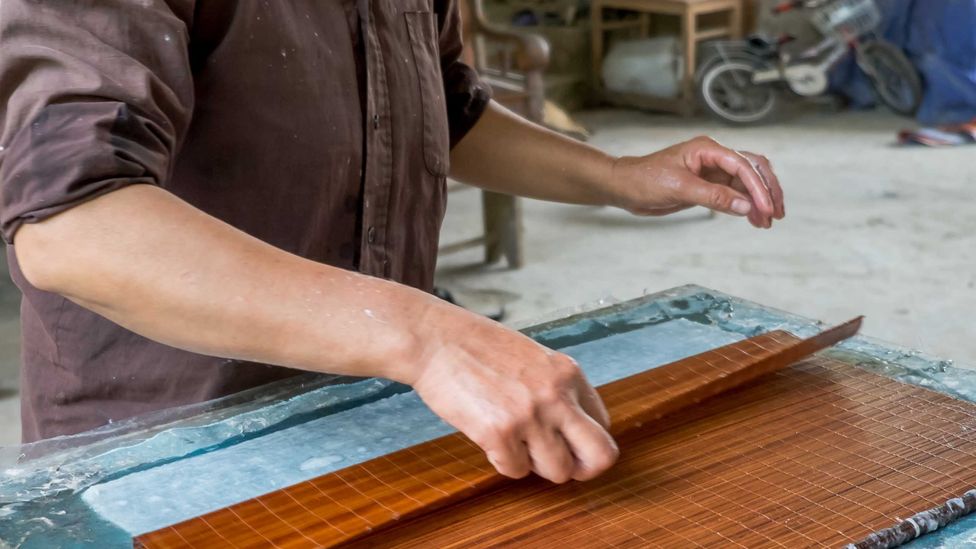
The bamboo mat is used to flatten the showtime blanket of a soon-to-be page (Credit: Kit Yeng Chan)
I'd come here with Tran Hong Nhung , a young entrepreneur from Hanoi, who founded social enterprise Zó project in June 2013 to help modernise this dying fine art.
Dating dorsum to the 13th Century, Dó was largely used in Vietnam equally a canvas for folk artwork, just was dying off in the face of Vietnam'due south rapid industrialisation that had rendered handmade crafts virtually obsolete over the last few decades. By producing notebooks, postcards, calendars and several dissimilar types of crude, robust newspaper that artists can use equally canvases, Zó project helps support the livelihood of impoverished villagers and preserves a forgotten but invaluable art.
We'd left the physical-lined avenues of the upper-case letter that morning time, zooming along the highway by tall and narrow houses that slowly thinned out into lush dark-green trees and rice paddies.
"[From] a papermaking perspective, [a natural environment] is a very proficient affair," Nhung told me.
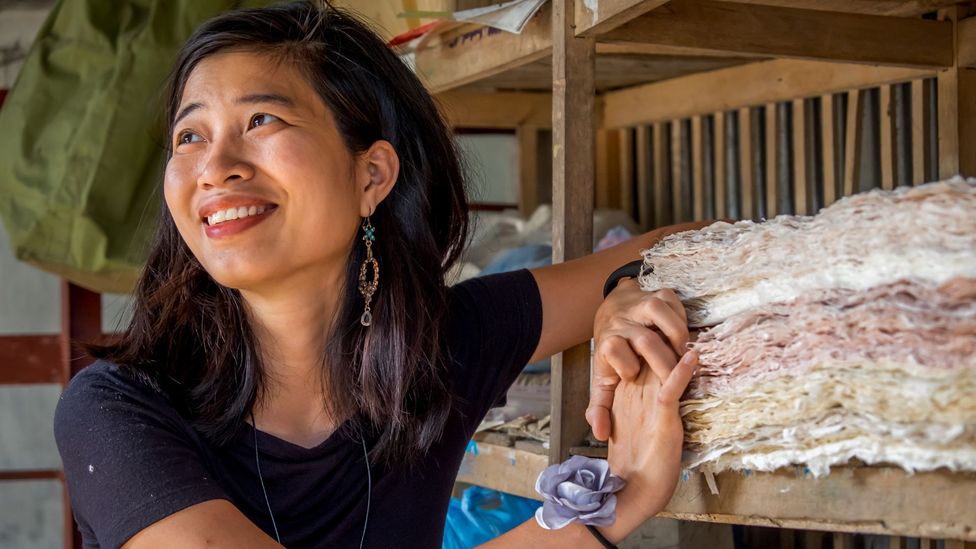
Tran Hong Nhung is the visionary entrepreneur who conceived of the projection (Credit: Kit Yeng Chan)
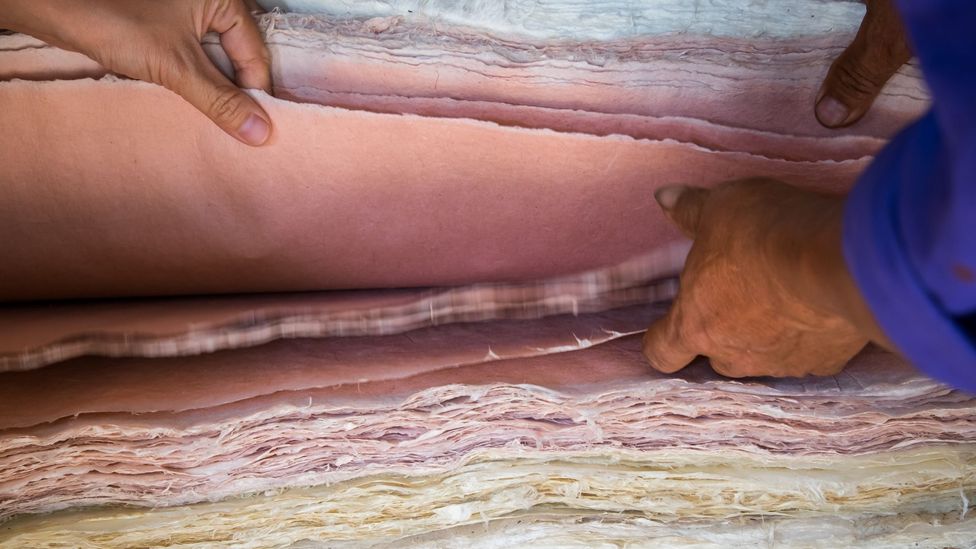
Produced from the bawl of rhamnoneuron balansae, a highly cellulose tree found in Northern Vietnam and China's Yunnan Province, Dó papermaking needs arable water, infinite and time. Traditionally, the tree bark would soak in limewater for well-nigh 3 months until information technology was soft enough separate from the lurid – though today, papermakers have managed to shorten this phase to only 24 hours. The pulp is and then pounded flat and smooth, and layered to form sheets of paper that are dried naturally in the lord's day for weeks. The result is beautifully soft, rustic paper that does non smudge ink, is highly resistant to humidity and acid-costless, attracts fewer termites, and most surprisingly, tin last for centuries.
Nhung started worrying about the state of Dó when she visited Duong O, the village where the art originated, well-nigh 40km northeast of Hanoi in the Red River Delta. There she found that just three families of papermakers remained. Challenged past the village's rapid urbanization, they were struggling to brand ends meet, to the point that they were well-nigh to give everything upward and wait for other, more than stable jobs.
I struggled to convince [the villagers] the tradition was worth saving, peculiarly because nobody from the younger generations was interested in keeping upwards the hard work," she explained. "The whole village had already transformed into a small town surrounded by factories. The space needed to produce handmade paper was no longer available, and on elevation of that, the water sources were completely polluted."
Zó project started working with the remaining papermakers of Duong O, merely encountered trouble afterward problem. The solution came when Nhung discovered a local NGO project, JICA foundation, which had previously worked with the impoverished village of Suoi Co. To help create jobs, the organisation had brought in a Japanese practiced to teach Suoi Co's villagers how to produce handmade newspaper.
"I admire the way Japan transformed their washi papermaking into a Unesco intangible cultural heritage, making it a desirable form of art in their order," Nhung said. "But Vietnam is dissimilar. We don't become whatsoever aid from the central authorities here."
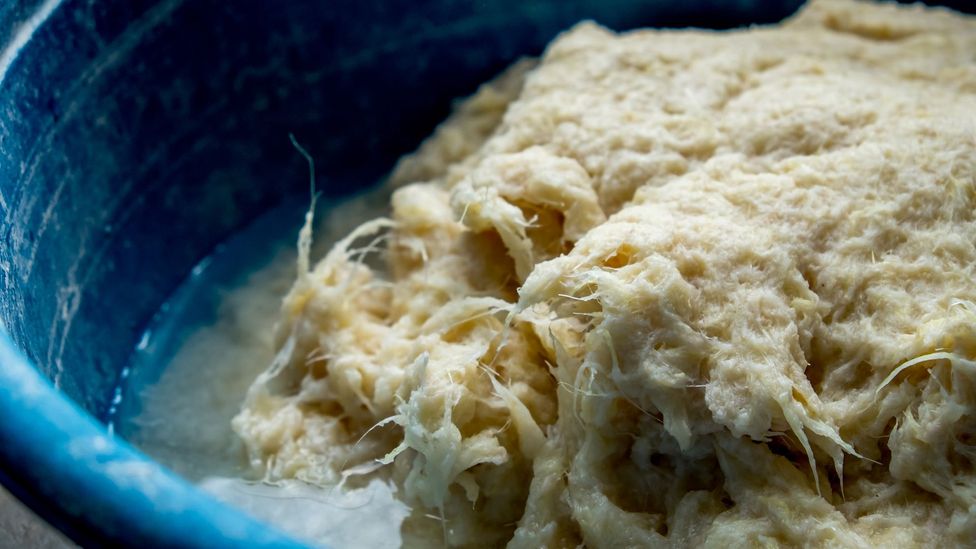
These fibres are made from the bawl of a highly cellulose tree establish in Northern Vietnam and People's republic of china'southward Yunnan Province (Credit: Kit Yeng Chan)
She realised that with their new set of skills, Suoi Co'south villagers could be the perfect match to revive Dó. Not but did they need jobs, simply they already had the natural resource – clean h2o and plenty of space – required to produce the aboriginal paper.
Today, Suoi Co is yet far from becoming a tourist attraction, simply its Dó workshop has huge potential. Surrounded by viridian paddies and low hills, it'southward such an platonic identify for an artist retreat – where travellers can study the papermaking process too as paint or work – that Nhung plans to open up equally soon equally funds permit. And the villagers, who previously had little ways of employment, are now able to make a livelihood.
In the concurrently, Nhung has travelled as far as Japan, Laos and Malaysia to promote the rebirth of Dó and learn most new handmade papermaking techniques. The ancient newspaper is now beingness distributed by art suppliers around the earth, also every bit fabricated into notebooks, postcards and other newspaper gifts that Nhung sells from her Zó Souvenir Shop, a pigsty-in-the-wall boutique in Ba Đình, Hanoi's railway commune, which ploughs all profits back into the papermaking project.
Dó paper has the potential to terminal upwards to a staggering 800 years (Credit: Kit Yeng Chan)
Regardless of the enthusiasm, the route ahead is steep. Most of Zó project'south acquirement is barely enough to support the costs of setting up this grassroots papermaking enterprise.
"At the moment, there are efforts to foyer social enterprise evolution in Vietnam, but I recall there's however a long way to go," Nhung said, as she gauged the quality of different sheets of freshly dried paper. Laid out on the floor, they glistened like crude diamonds in the afternoon sun.
For the moment, the future of this precious art course rests in the hands of this adult female and her pocket-sized group of artisans.
Source: https://www.bbc.com/travel/article/20160817-the-handmade-paper-that-lasts-800-years
0 Response to "What You Need to Know About Handmade Paper"
Post a Comment